Threat intelligence involves collecting data on cybercriminals, data breaches, and vulnerabilities, analyzing it, and turning it into actionable insights. It works in real time and alerts you if your credentials are for sale on a forum before anyone can use them.
In this article, you’ll discover why speed matters, how to identify and mitigate risks with a continuous approach, what AI brings to the table, and what a good threat intelligence platform should offer.
What is threat intelligence, and what is it used for?
It is also known as CTI, an acronym for Cyber Threat Intelligence. It consists of pre-analyzed information about who might attack you, how, and with what means. It’s not a list of alerts; instead, it provides a comprehensive overview to help you decide where to focus first.
Most security tools operate within your network, once an attack has already begun. Threat intelligence operates externally, through forums, marketplaces, and data leaks where attacks are planned. That’s why it lets you act before an attack occurs, rather than just responding to it.
Why is it necessary to act in real time?
Because attackers move faster than most security teams. According to Verizon’s DBIR 2026 report, exploiting vulnerabilities is already the number one entry point. It accounts for 31% of breaches. In addition, attackers use generative AI at various stages of the attack, from reconnaissance to malware deployment.
Waiting too long to act can come at a very high cost. According to the report IBM’s “Cost of a Data Breach 2026” report, it takes an average of 247 days to identify and contain a data breach. The average global cost is $4.99 million, up 12% from last year.
How to Identify and Mitigate Risks Using a CTEM Approach?
The short answer is to use a continuous cycle rather than one-off cybersecurity audits. That is what CTEM stands for: Continuous Threat Exposure Management. Gartner introduced this framework in 2022, consisting of five phases.
| Phase | What are you doing? | Example |
| Defining the Scope | Decide Which Assets Matter | Domains, brands, and executives |
| Detection | Identify what’s exposed | Leaked credentials or forgotten subdomains |
| Prioritization | Sort by actual risk | A manager’s input carries more weight than an email from the marketing team |
| Validation | Check whether it can be exploited maliciously | Is the leaked credential still active? |
| Mobilization | Assign and Correct | Password changes and access revocation |
Kartos and Qondar, Enthec’s cyber-surveillance solutions, follow this logic. Kartos continuously monitors a company’s exposure surface. Qondar does the same for personal security.
How does AI help with threat intelligence?
AI makes it possible to scan thousands of sources—in multiple languages and including images—something no analyst can do manually. But it has also made things easier for attackers, who are exploiting its full potential to find loopholes. That’s why cyberintelligence needs AI on its side.
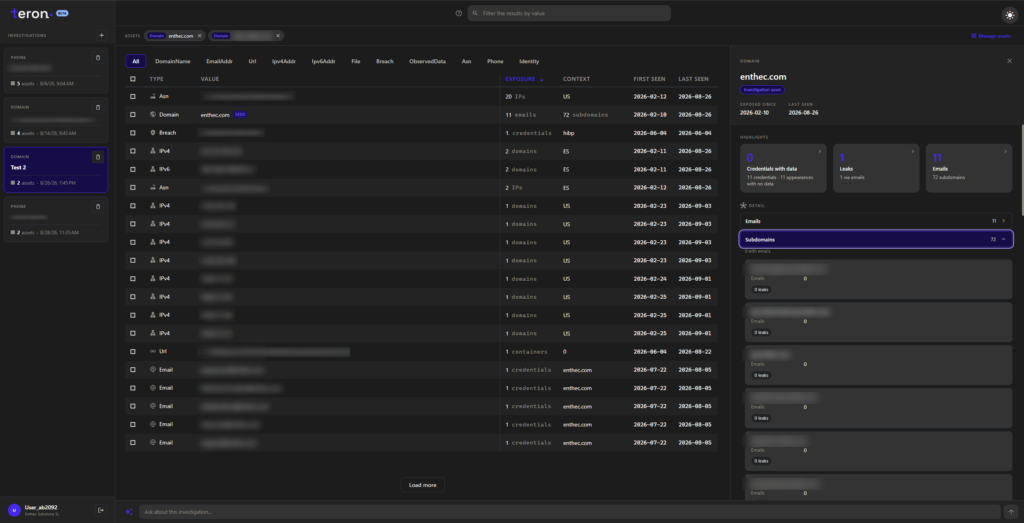
This is where Teron, the research module of the Enthec platform. It’s a search tool for emerging threats, compromised assets, and adversaries, powered by AI analysis. Teron processes and prioritizes hundreds of thousands of records per day in a practical way:
- Search cybercriminal forums, peer-to-peer networks, leaked databases, messaging channels, and dark web marketplaces.
- Enrich each finding with its source, risk level, and connections to other campaigns.
- Analyze images to detect logos, text, and exposed credentials in screenshots, in any language.
- Save each investigation as a file that the team can revisit and share.
While Kartos and Qondar tell you what’s being exposed, Teron lets you pull the thread—for example, to trace a leaked credential back to the person selling it. Plus, it’s 100% European technology and is audited by AENOR (ISO 27001 and ENS High Level).
Threat Intelligence Platform: What Should It Include?
A good platform provides actionable context—not just data—and you can see the difference in the team’s day-to-day work. Before signing up for one, check these five things:
- It covers the real criminal world, not just public sources.
- Provides each data point along with its source, risk level, and relationships.
- It uses standards such as STIX to integrate with your tools.
- Allows you to save and share investigations.
- Complies with European regulations and is auditable.
Be wary of platforms that show you thousands of metrics without context. That’s just well-presented noise, and your team will end up ignoring it. It’s better to receive five alerts with context than five hundred without it.
Want to know what people are already saying about your company in those forums? You can put your company to the test with Teron or request a Kartos demo.
Frequently Asked Questions
What is the difference between threat intelligence and antivirus software?
Antivirus software blocks known threats on your devices. Cyber intelligence looks outside your network—where attacks are being prepared—and alerts you to leaked credentials, campaigns, or access credentials being sold. These are different layers that complement each other, so it’s not a good idea to replace one with the other.
Does Your Small or Medium-Sized Business Need Threat Intelligence?
Yes, although on a different scale. Attackers go for the easy targets, not the big ones, and a leaked credential works just as well against an SME as it does against a multinational corporation. A continuous monitoring tool is enough to get started, without setting up your own team of analysts or spending weeks configuring it.
How does CTEM differ from a vulnerability scanner?
The scanner checks your systems periodically. CTEM is a continuous cycle that identifies, prioritizes, and validates vulnerabilities. It includes compromised credentials and assets you didn’t even know you had, and connects them with the right people to fix them.
What is the difference between Kartos, Qondar, and Teron?
Kartos monitors companies’ exposure, and Qondar monitors individuals’ exposure—both on an ongoing basis. Teron is the research module; it starts with a specific data point and digs deeper. All three share the same platform and session.